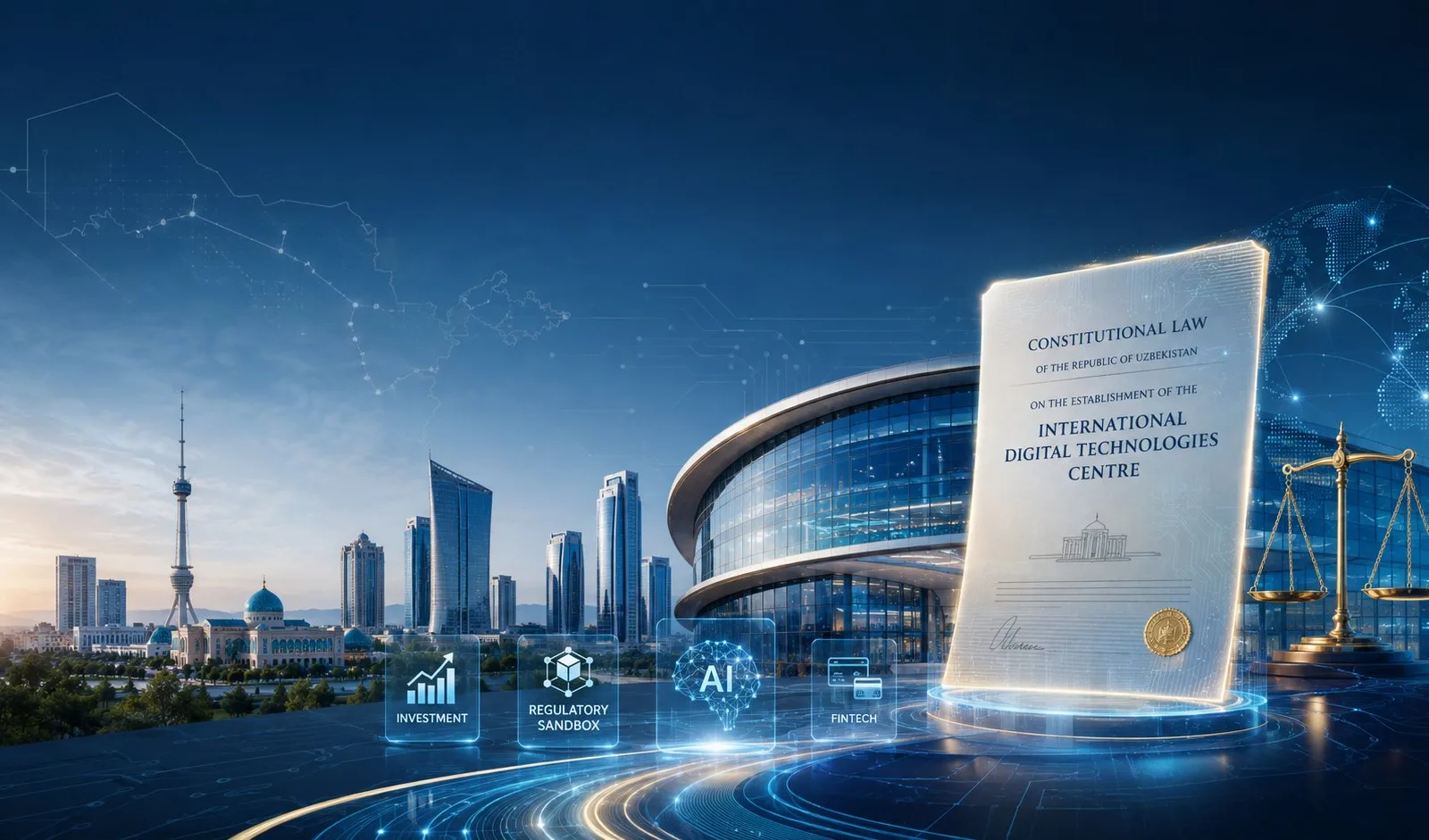
On 19 August 2026, President of the Republic of Uzbekistan Sh. Mirziyoyev signed the Constitutional Law “On the International Digital Technologies Centre.” The Law was adopted by the Legislative Chamber on 4 August and approved by the Senate on 8 August 2026, entering into force six months after its official publication.
What the Centre Is and Why It Was Established
The Centre is a special territory operating under a special legal regime, established to develop Uzbekistan’s digital economy. Its principal objectives are to attract investment into the digital technology sector, to create conditions for testing innovative products and services within a regulatory sandbox, and to promote export activity in the IT sector. The special legal regime remains in effect until 2100.
Applicable Law
One of the Centre’s most notable features is its unique hierarchy of applicable law. On its territory, priority is given to the Constitution of the Republic of Uzbekistan, the Constitutional Law, and the decisions of the Centre’s Governing Board. Where gaps exist, the principles and rules of the common law and equity of England and Wales apply additionally. English is established as the official language of administration, and in the event of any discrepancy between texts in different languages, the English version takes absolute precedence.
Governance Structure
The Centre is governed by two bodies. The Governing Board is the supreme collegial body, chaired by the President of the Republic of Uzbekistan. It sets strategic directions, approves decisions, and ensures the long-term protection of investors. The Centre Administration is the executive body established as a joint-stock company and is responsible for operational activities, participant registration, monitoring, and oversight. All decisions of the Centre are published in English and take effect from the date of official publication.
Participants and Investors
Residents of the Centre are legal entities carrying out activities on its territory in approved categories. They may operate as local or foreign companies, as well as branches and representative offices. The Law identifies four categories of investors — institutional (funds and financial institutions), startup investor, resident investor, and infrastructure investor — each with its own set of benefits and preferences. Accredited partners are legal entities and individuals providing the Centre’s subjects with legal, audit, consulting, and other ancillary services.
The Regulatory Sandbox
The Centre enables the testing of innovative technologies, products, and services within a special experimental legal environment. It is introduced for a period of up to 12 months and provides for temporary exemption from certain regulatory requirements, access to the Centre’s infrastructure, and the opportunity to engage with real consumers in a supervised market environment. Following testing, successful projects may be scaled up or referred to competent authorities for implementation across the entire territory of the Republic of Uzbekistan.
Tax and Customs Benefits
The Centre’s special tax regime provides for exemption from all taxes and levies established by the legislation of the Republic of Uzbekistan on income earned within the special legal regime. The taxes that remain applicable are VAT at a zero rate for transactions within the Centre and for exports, corporate income tax at a rate determined by a decision of the Centre, and personal income tax. Foreign highly qualified employees are fully exempt from personal income tax, the rate for other foreign employees is 12 per cent, and for citizens of the Republic of Uzbekistan it is 7.5 per cent. In the customs sphere, exemption from VAT and duties on the import of equipment and materials is provided, alongside zero export duties and simplified electronic customs clearance with declarations reviewed within two business days.
Investment Protection and Labour Relations
The Law establishes firm guarantees for the protection of the assets of the Centre’s subjects: property may not be confiscated, nationalised, expropriated, or frozen except in cases expressly provided for by law. Labour relations are built on the principles of contractual freedom. The Law permits flexible working arrangements, remote work, and alternative remuneration systems. Foreign employees are exempt from the requirement to obtain a work permit and may enter the country on visas valid for up to three years.
Finance, Data, and Intellectual Property
The Centre permits the provision of a full range of financial and banking services, including venture investment and payment technologies. The opening of branches of foreign banks is possible with the consent of the Central Bank of the Republic of Uzbekistan. The processing of personal data is governed in accordance with international standards. Rights to intellectual property objects are protected on the basis of international norms and decisions of the Centre, with the Law expressly encouraging the creation and commercialisation of the results of intellectual activity. In the field of artificial intelligence, the freedom to develop, test, and apply relevant technologies is guaranteed.
Dispute Resolution
All disputes involving the Centre’s subjects are heard by the Tashkent International Commercial Court, which applies the Centre’s special legislation, including the rules of common law. Its jurisdiction encompasses civil, corporate, labour, and economic disputes, insolvency and restructuring cases, and matters of international arbitration.
Conclusion
The establishment of the International Digital Technologies Centre represents one of the most significant regulatory reforms in Uzbekistan’s history in the field of IT and investment. The unique combination of English common law, zero tax rates, free engagement of foreign specialists, and the regulatory sandbox instrument creates a fundamentally new environment for international technology business in Central Asia.